Hearts: Card Game
- 4.6
- Rating
- 1.00M
- Installs
- Free
- Price

 Analysis by App-foxy
I keep coming back to Hearts: Card Game for one simple reason: it respects the small amount of time I usually have for a card game. The central appeal is the ability to play a familiar Hearts match online or offline, so I can use it when I have a connection and still return to it when I am travelling, waiting somewhere, or trying to relax without depending on a network.
That flexibility sounds modest, but it changes how the game fits into daily life. I do not have to reserve a long uninterrupted session for it, and I am not forced to treat every match as a social event. At the same time, the rules leave enough room for careful decisions that it feels more substantial than a purely casual tap-through game. MobilityWare has built this release as a straightforward card game for Android, and its broad appeal is reflected in an average rating of 4.5 from roughly 57 thousand ratings.
Why online and offline play matters here
Hearts is already a game that works well in short bursts, but offline access makes those bursts much easier to plan. In my experience, the most useful scenario is not a dramatic long journey; it is the ordinary gap between activities. I can start a hand while waiting for an appointment, put the phone away when my name is called, and return to another round later without needing to find a stable connection first.
You May Also Like

 Blood Strike: 2.5 Anniversary
Blood Strike’s Loadouts Turn Every Drop Into a Tactical Gamble
A close look at Blood Strike’s custom loadouts: how fast access to signature weapons reshapes its battle royale rhythm, rewards preparation, and narrows the gap between fights.

 Pandora - Music & Podcasts
Pandora’s Music Is Easy to Start, but Harder to Recover
Pandora’s strength is its low-effort path from a seed to a station. Its weak spot is how much confidence it asks you to place in connection, setup, and quiet recovery.

 8 Ball Pool
 Is Built on Rivalries, Rematches, and Routine
A close look at the rivalries, rematches, shared routines, and unanswered safety questions that turn a quick pool match into a persistent mobile community.

 Samsung Music
’s Quiet Strength Is Playing What You Already Own
Its reach comes less from spectacle than from dependable access to a personal library. That simplicity is both the app’s strongest retention engine and its ceiling.

 AccuWeather: Weather Radar
AccuWeather Review: A Quick, Clear Forecast for Everyday Decisions
For everyday plans, the best forecast is the one you can understand quickly. AccuWeather makes rain timing, radar, and local conditions easy to act on, with a few trade-offs.

 Hill Climb Racing
Why Hill Climb Racing Still Turns Crashes Into One More Run
A tiny car, a bumpy hill and one more upgrade: Hill Climb Racing keeps resurfacing because its simple chaos makes every near-miss feel personal.
More From Our News Desk



Online play has a different effect. It gives the game a more connected feel when I want competition beyond a solitary session. The important distinction is that I am not choosing between a permanently connected game and nothing at all. I can use the same card-game app in two different situations, which makes it more practical than a Hearts title that only works when the network is available.
That capability also suits people who prefer to control their own pace. Some players want to sit down for a focused match; others want a quiet distraction that can be interrupted. Hearts accommodates both habits better than many card games that are built around constant interaction, timed turns, or a single online format. The real strength is continuity: the game remains useful when your surroundings change.
What a round feels like on a phone
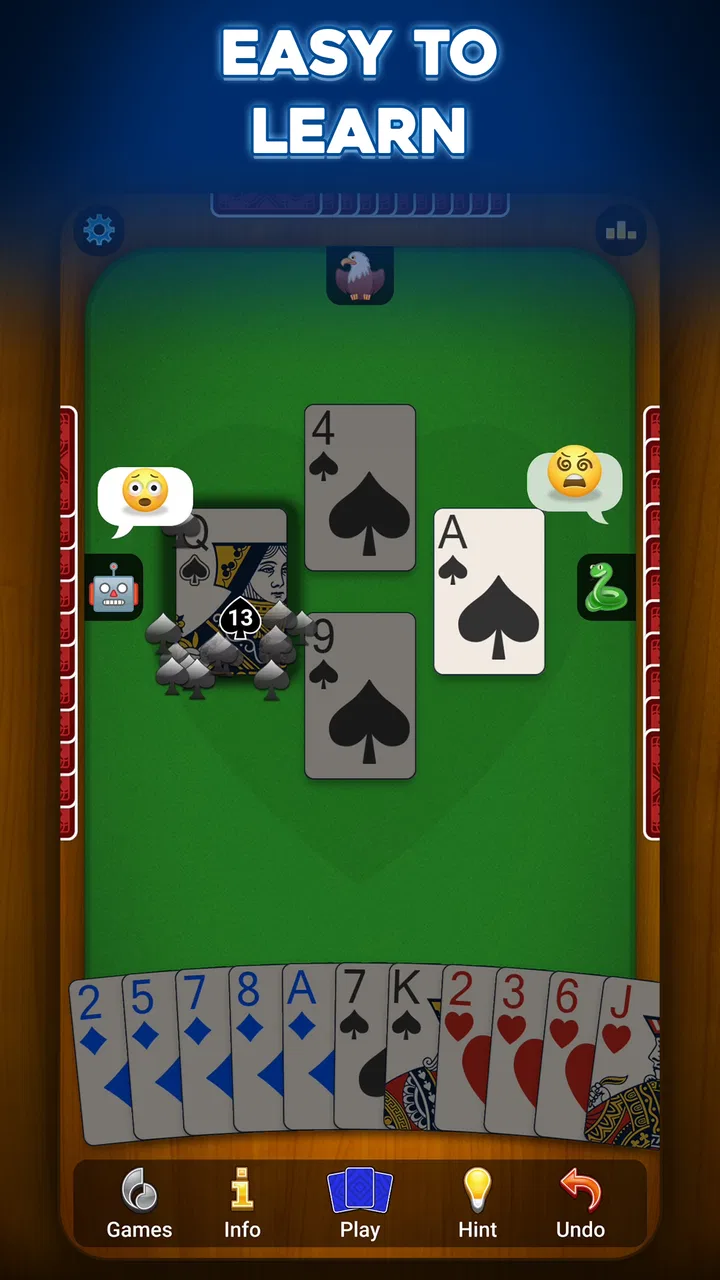
The core experience is recognizable immediately if you already know Hearts. You follow the play of the hand, watch which cards have been used, and decide whether to take a trick or avoid one. On a small screen, those decisions need to be readable rather than buried under decoration, and this game benefits from the fact that its identity comes from the cards themselves.
I find the best way to approach a session is to treat each hand as a short exercise in risk management. A tempting high card is not automatically useful, and a low card is not always safe. The current trick, the suits that have already appeared, and the cards I may be forced to play later all matter. That makes the game accessible at the start but less mindless than it first appears.
The offline option is especially valuable for learning that judgment. A newcomer can take time to understand why a move was uncomfortable without worrying about holding up another person. I would not describe the game as a tutorial-heavy learning tool, but repeated hands naturally teach the rhythm of Hearts: shed dangerous cards when the opportunity is right, keep track of what remains, and avoid making a choice only because it looks harmless in the moment.
A practical routine for better decisions
My most useful habit is to pause briefly before every awkward play and ask what the next two tricks might look like. That small delay prevents the common mistake of judging a card in isolation. If I have already seen several cards from a suit, I can make a more informed guess about whether I am likely to be forced to play from it later. This is not a special mode or hidden system; it is simply the kind of attention the app rewards.
Another helpful approach is to use offline matches as a low-pressure practice space rather than rushing through them. I pay attention to the cards I am avoiding, not just the ones I am trying to win. That shift makes the game more strategic and helps me recognize when keeping a seemingly good card is actually creating a problem for a later trick.
For experienced Hearts players, the value is different. The app is convenient because it removes setup: there is no physical deck to shuffle, no score sheet to prepare, and no need to find three people at the same time. I can play a few hands when I want to keep my instincts sharp, then stop without turning the session into a major commitment.
Where it fits better than the usual alternatives
Compared with a physical deck, this game is faster to start and easier to use alone. A real deck is better when friends are sitting around the same table and conversation is part of the entertainment. The app cannot reproduce that shared-room feeling, but it is much more convenient when the other players are unavailable or when I only have a few minutes.
Compared with other digital card games, Hearts: Card Game feels less dependent on spectacle. It is not trying to replace a full collection of different games or turn every hand into a complicated event. That narrow focus is a benefit if Hearts is what I actually want. It is a weakness if I expect solitaire, poker, rummy, or a large selection of unrelated card modes from one download.
Online play can be the better choice when I want the energy of facing other people, while offline play is preferable when I need reliability and privacy. I would choose a different app for a highly social card-table experience, especially if my main goal were chatting with friends during a match. I would choose this one when the priority was simply getting into a Hearts hand quickly, with fewer conditions around the session.
The everyday use case that convinced me
My ideal use case is a commute or a waiting room where I cannot predict how long I will be there. I can play a hand offline, stop without feeling that I have abandoned a live match, and continue later when the day settles down. That makes the game more useful than an app that demands a fixed block of attention.
It also works well at home when I want something more engaging than scrolling but less demanding than a large strategy game. A few hands give me a clear activity with a beginning and an end. I can concentrate on the cards, then put the phone down. That sense of a contained session is one of the reasons I would recommend it to someone who wants a calm digital pastime rather than an endless feed.
Families can also find it approachable because the content rating is Everyone. I would still explain the rules to a younger player rather than assuming the app alone will teach every nuance, but the basic card structure is familiar enough for a broad audience. Adults who remember playing Hearts with a physical deck will probably understand the appeal quickly; newcomers may need several hands before the strategic patterns become comfortable.
The tradeoffs behind the convenience
Offline play is convenient, but it can also make the experience feel more solitary. If I want lively conversation, immediate reactions, or the tension of knowing a real person is waiting on my move, a physical game or a more socially focused online alternative may be more satisfying. The capability solves access problems; it does not turn a solo session into a gathering.
There is also a limit to how much variety I expect from a focused Hearts app. Once I have played enough hands in one sitting, the familiar structure can become repetitive. I usually avoid that by keeping sessions short instead of forcing myself to continue after the decisions start feeling automatic. Someone looking for constant novelty may prefer a broader card-game collection.
The game is free to download, which makes trying it low-risk, but in-app purchases range from $4.99 to $29.99 per item. I would recommend checking the purchase prompts carefully and deciding in advance whether optional extras are worth paying for. The free entry is helpful, although anyone who dislikes monetization in casual games should keep that part of the experience in mind.
Device compatibility is also worth checking before installing. The current version is 2.5.0.2775 and requires Android 8.0 or later. That is not a concern on a reasonably modern Android phone, but an older device may not be eligible. The game has passed one million installs, so it is clearly not an obscure experiment, yet popularity alone does not guarantee that it will suit every player’s preferred style.
Small habits that make the game more rewarding
I get more from the app when I separate “winning this trick” from “having a good hand.” Hearts often punishes the instinct to collect every attractive opportunity. Before playing a strong card, I consider whether taking the trick will leave me exposed later. That mindset is useful for people moving from casual play to more deliberate decision-making.
I also recommend using the offline capability when learning the shape of a hand, then switching to online play once the basic rhythm feels natural. Practising away from pressure lets me focus on suit distribution and card tracking. Online sessions can then become a test of judgment rather than a first lesson in the rules.
A third tip is to stop after a clear mistake and identify the cause instead of immediately starting another hand. Was I trying to win a trick that I should have avoided? Did I forget which suits had already been played? Did I keep a dangerous card too long? That quick review turns a casual match into useful practice and is one reason the game has more depth than its simple presentation suggests.
Who will get the most from it
I think this is a strong fit for people who already enjoy Hearts and want a dependable version on their phone. It is also suitable for beginners who want to learn gradually, because the offline format gives them room to experiment without the pressure of a live opponent. Commuters, travellers, and anyone who often has unpredictable spare time will benefit most from the ability to play without staying connected.
It is less suitable for someone who wants a large catalogue of card games, a deeply social table, or a heavily competitive environment in every session. I would also hesitate to recommend it to a player who finds repeated hands boring unless the strategic side of Hearts is already appealing. The focused design is its identity, not a temporary limitation that should be ignored.
MobilityWare has kept the experience approachable enough for a wide audience while leaving room for players to improve through better observation. The rating of Everyone supports its accessibility, and the free price makes it easy to test without committing money at the start. Just remember that optional purchases are available, and treat them as a separate decision rather than part of the basic reason to install.
My final take after using it
I would recommend Hearts: Card Game to a friend who wants one familiar card game that can adapt to both connected and disconnected moments. The online and offline capability is not merely a checkbox: it determines whether the app remains useful when the internet is unreliable, the schedule is crowded, or a short break suddenly appears.
Its limitations are straightforward. It does not replace a table full of friends, it may feel repetitive if played for too long, and players seeking a broad card collection should look elsewhere. But for focused Hearts sessions, the balance is convincing. I can start quickly, think carefully, stop when I need to, and return later without rebuilding the whole experience.
With an average rating of 4.5 and more than one million installs, it has already found a substantial audience. My own recommendation is narrower and more practical: choose it if the familiar rules of Hearts are the attraction and flexible play matters more than constant novelty. If that describes you, this is a convenient card companion rather than just a quick time-killer.
FAQs for Hearts: Card Game
01What is Hearts: Card Game and how is it played?
Hearts: Card Game is a classic trick-taking card game where the objective is to avoid accumulating points. Players must try to avoid certain cards, primarily the hearts and the queen of spades, which add penalty points. The game is played with four players, and the winner is the one with the fewest points when a player exceeds 100 points.
02Is Hearts: Card Game suitable for beginners?
Yes, Hearts: Card Game is suitable for beginners as well as seasoned players. The rules are straightforward, making it easy to learn. New players can start with basic strategies and gradually explore more advanced techniques as they become familiar with the game dynamics.
03Does Hearts: Card Game offer multiplayer options?
Yes, Hearts: Card Game often includes both single-player modes against AI and online multiplayer options. Players can enjoy matches with friends or join random online lobbies to compete against others worldwide. This versatility enhances the gaming experience by catering to different play styles.
04Are there any in-app purchases in Hearts: Card Game?
Some versions of Hearts: Card Game may include in-app purchases. These can range from cosmetic upgrades, such as card themes and backgrounds, to eliminating ads or gaining access to premium features. It’s advisable to check the app details to understand what purchases are available.
05What are the common strategies to win at Hearts: Card Game?
A common strategy in Hearts is ‘shooting the moon,’ which involves taking all the hearts and the queen of spades to give other players penalty points. Players can also try to void a suit early to control the gameplay. Understanding opponents’ strategies and adjusting yours accordingly is key to success.
Pros
- Simple
- intuitive interface for easy navigation.
- Multiplayer mode enhances social interaction.
- Customizable rules for personalized gameplay.
- Offline mode available for uninterrupted play.
- Minimal ads ensure a smooth experience.
Cons
- Occasional connectivity issues in multiplayer.
- Limited in-game tutorials for beginners.
- Slow updates on new features.
- In-app purchases can be costly.
- Graphics could be more visually appealing.

Hearts: Card Game
Gallery